Where Public Money Goes: The 2026 Budget Explained

Public budgets are usually reported as a single number, and that is the first problem. A headline figure tells you almost nothing about what a government will actually do. The useful questions are smaller and more specific: which departments gained, which lost, what is being paid for with borrowed money, and how much of the plan depends on assumptions that may not hold.
This year's budget cycle is a good example. The overall total looks stable, but underneath it the mix has shifted. Recurring costs such as health, pensions and debt interest are taking a larger share, while spending on maintenance and new projects is squeezed. That is not a dramatic story, but it is the one that will shape public services long after the press conference ends.
Where the money comes from
Most public revenue arrives through a small number of channels: income tax, consumption taxes, corporate tax, property levies and transfers from higher levels of government. Each has a different feel for the payer. Income tax is visible on a payslip. Consumption tax is hidden in the price of everything. Property tax is felt once or twice a year and often provokes the loudest reaction.
When a government promises not to raise headline income tax, it usually means the money will come from somewhere else: a frozen threshold, a new levy, higher fees or more borrowing. None of those are automatically bad, but they are choices, and they should be described as choices. A useful budget document says which one is being used and who pays more as a result.
Borrowing deserves its own line. Debt is not free money; it is spending moved into the future with interest attached. When rates rise, the same debt costs more every year, and that cost competes directly with schools, clinics and road crews. The International Monetary Fund publishes plain-language material on how fiscal space shrinks when interest bills grow.
What the money pays for
Health and social care almost always dominate. These are labour-heavy services, so their costs rise with wages, demographics and the complexity of care. An ageing population does not just mean more hospital beds; it means more home visits, more chronic conditions and more people needing support for longer. Budgets that flat-fund these services in cash terms are usually cutting them in real terms.
Education is the second big block, and the most politically sensitive. Teacher pay, building repairs and classroom materials compete within the same envelope. A rise in the headline schools budget can disappear quickly if energy bills and insurance costs rise faster. Parents tend to notice the result before they notice the accounting: larger classes, fewer trips, delayed repairs.
Then there is the category that quietly decides daily quality of life: maintenance. Roads, water pipes, bridges, public buildings and drainage are cheap to ignore for a year and expensive to ignore for a decade. Deferred repairs do not vanish. They return as closures, leaks and emergency contracts priced at a premium. In budget documents this often appears as a capital plan with projects listed years into the future, which is another way of saying the work has not started.

The promises that are easy to announce
New programmes photograph well. Ribbon cuttings, pilot schemes and one-off grants produce visible results within a political cycle. Maintenance does not. A repaired pipe is invisible when it works, and a road that is not closed attracts no attention. That asymmetry pushes money toward the new and away from the necessary.
Tax cuts have the same appeal. A cut is easy to explain and easy to feel, at least in the short term. The harder question is what happens to the services that depended on that revenue. If the answer is "efficiency", it is worth asking where the efficiency has been hiding and why it was not already captured. Sometimes the answer is real. Often it is a placeholder.
Readers should also watch for accounting choices: moving spending off the main budget, labelling a cost as an investment, or using a one-off reserve to cover a recurring expense. Each can be legitimate in isolation. Used repeatedly, they hide a structural gap that eventually has to be closed.

How to read the document yourself
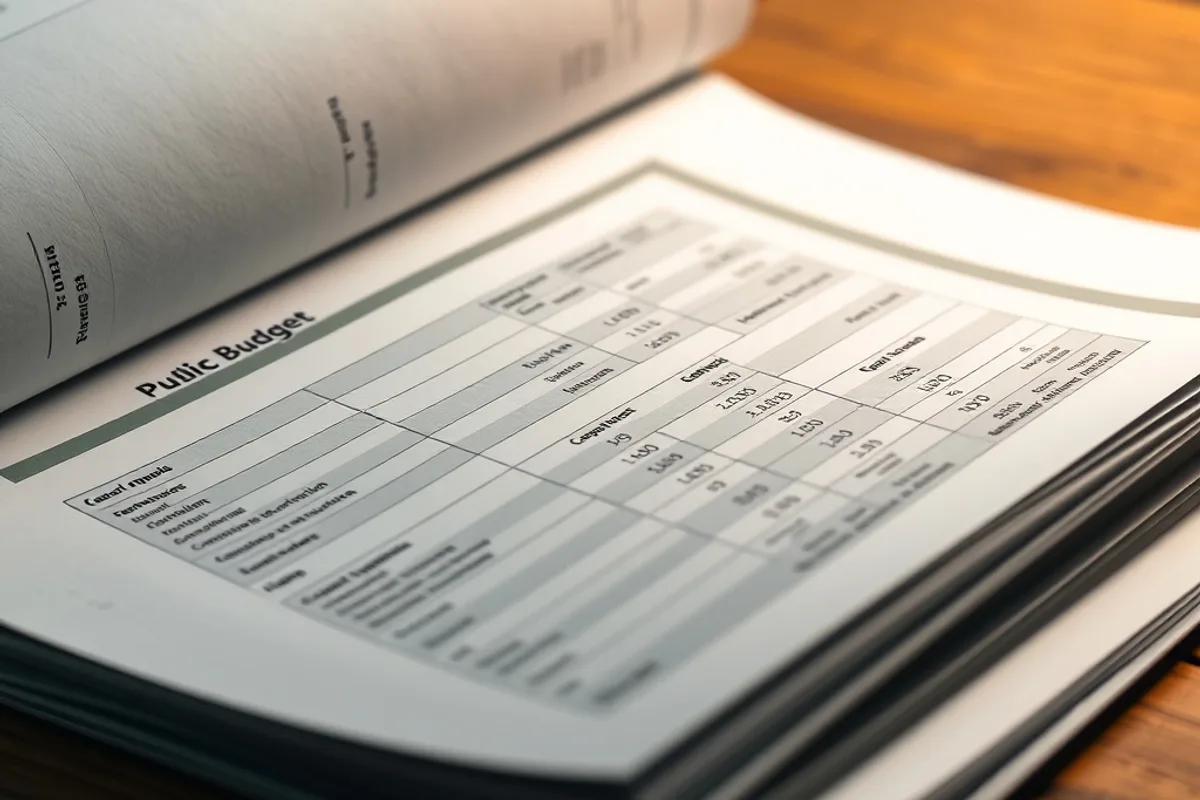
You do not need to read every page. Start with the summary tables, then find the department you care about and compare its allocation with last year after adjusting for inflation. Look for the difference between "allocated" and "spent"; the gap tells you how realistic the plan is. Check the assumptions for growth, wages and interest rates, because every projection depends on them.
- Compare in real terms. A budget that rises by two percent while prices rise by four percent is a cut.
- Separate recurring from one-off money. A grant that expires next year cannot fund a permanent service.
- Follow the maintenance line. It is the best early warning of future costs.
- Read the debt section. Interest is spending that produces nothing visible but consumes real money.
The budget is one of the few documents that touches every household, whether or not anyone reads it. Treating it as a political scoreboard misses the point. It is a plan for who gets help, who waits and who pays, and it deserves to be read that way.

What happens next
Budgets are passed, but they are not finished. Departments will interpret the numbers, contracts will be signed, and mid-year reviews will adjust the plan. Local councils will make their own choices within the envelope they receive. That is where the gap between announcement and outcome usually appears.
The most useful thing a reader can do is pick one service they use and follow it through the year. Does the library stay open? Is the clinic fully staffed? Was the road actually resurfaced? Budgets are abstract until they are not, and the moment they become concrete is the moment accountability starts.
A budget is not a spreadsheet. It is a ranked list of who matters, written in numbers.Chauncey Apuzzi Editorial
We cross-check every claim against primary documents and independent reporting. Where a story depends on public records or official data, we link to the source so you can verify the numbers yourself.